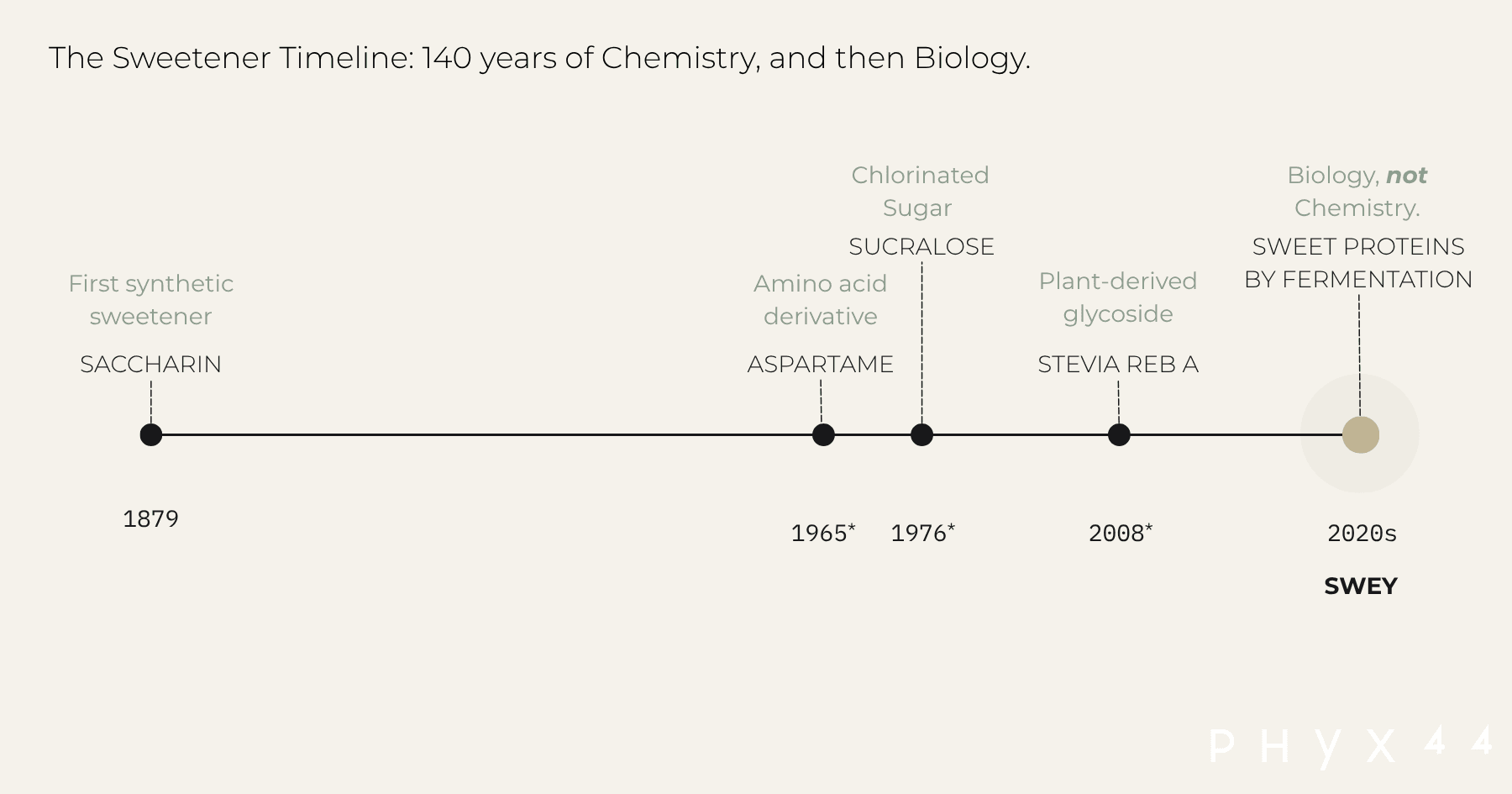
*1965 - Aspartame (discovery), 1976 - Sucralose (discovery), 2008 - Stevia RebA Approval
Something significant is converging around sugar.
In the last few months, guidance from health authorities around the world has continued its (multi-year) shift towards lower sugar intake — not only for caloric reasons, but for metabolic health.
‘GLP-1’ has crossed into mainstream culture. It is perhaps the most visible evidence of a population-wide reckoning with metabolic disease.
In June 2026, Ingredion — a major global ingredients company — announced its acquisition of T&L Sugars, a signal that even the incumbents of the sugar value chain are beginning to consolidate their position — they're anticipating major structural disruption.
Coincidence? We don't think so. These events are from the latest chapter of a story that has been running for over a century: humans trying to solve a biology problem with chemistry.
A hundred years of workarounds
The industrialised food system runs on sucrose. It provides energy density, enables bulking, improves texture and mouthfeel, and — most importantly — tastes good.
As a result, it is consumed in humongous quantities owing to the demands of modern processed food. This triggers a well-documented cascade of consequences: type 2 diabetes, obesity, non-alcoholic fatty liver disease, dental decay.
The industry's response has been creative, persistent, and ultimately insufficient.
Saccharin, discovered in 1879, was the first synthetic sweetener — it tastes metallic in quantity. Aspartame, approved in 1981, has been the subject of public controversy for decades, despite repeated regulatory review concluding it is safe at approved levels. Sucralose is stable at high temperatures but is increasingly restricted or cautioned against in baking because prolonged heating can cause it to break down and potentially form harmful chlorinated compounds. Stevia-derived rebaudioside extracts are natural in origin but bitter in their high-purity forms, requiring masking agents and bulking compounds that add formulation complexity and cost.
Each of these alternatives, in essence, solved the most immediate problem — sweetness without sucrose — while creating new ones: taste profile constraints, processing challenges, consumer perception problems, regulatory review cycles.
The underlying problem was never fundamentally addressed by any of them. Because the problem was never chemical. It was biological.
What nature already knew
Plants have been producing intensely sweet proteins for millions of years. Not as sweeteners, but as signals — a way to attract seed-dispersing animals to their fruit.
Thaumatin, isolated from the West African katemfe fruit (Thaumatococcus daniellii), is reported to be 2,000–3,000 times sweeter than sucrose by weight. Monellin, from the serendipity berry (Dioscoreophyllum cumminsii), is approximately 3,000 times sweeter. Brazzein, from a West African plant (Pentadiplandra brazzeana), combines sweetness intensity with thermal stability — a property that matters considerably in food manufacturing applications.
These proteins interact with the same taste receptors as sucrose. They bind with high affinity to the T1R2/T1R3 heterodimer complex on the tongue and produce a perceived sweetness that is, in qualitative terms, closer to sugar than any synthetic molecule has managed to achieve.
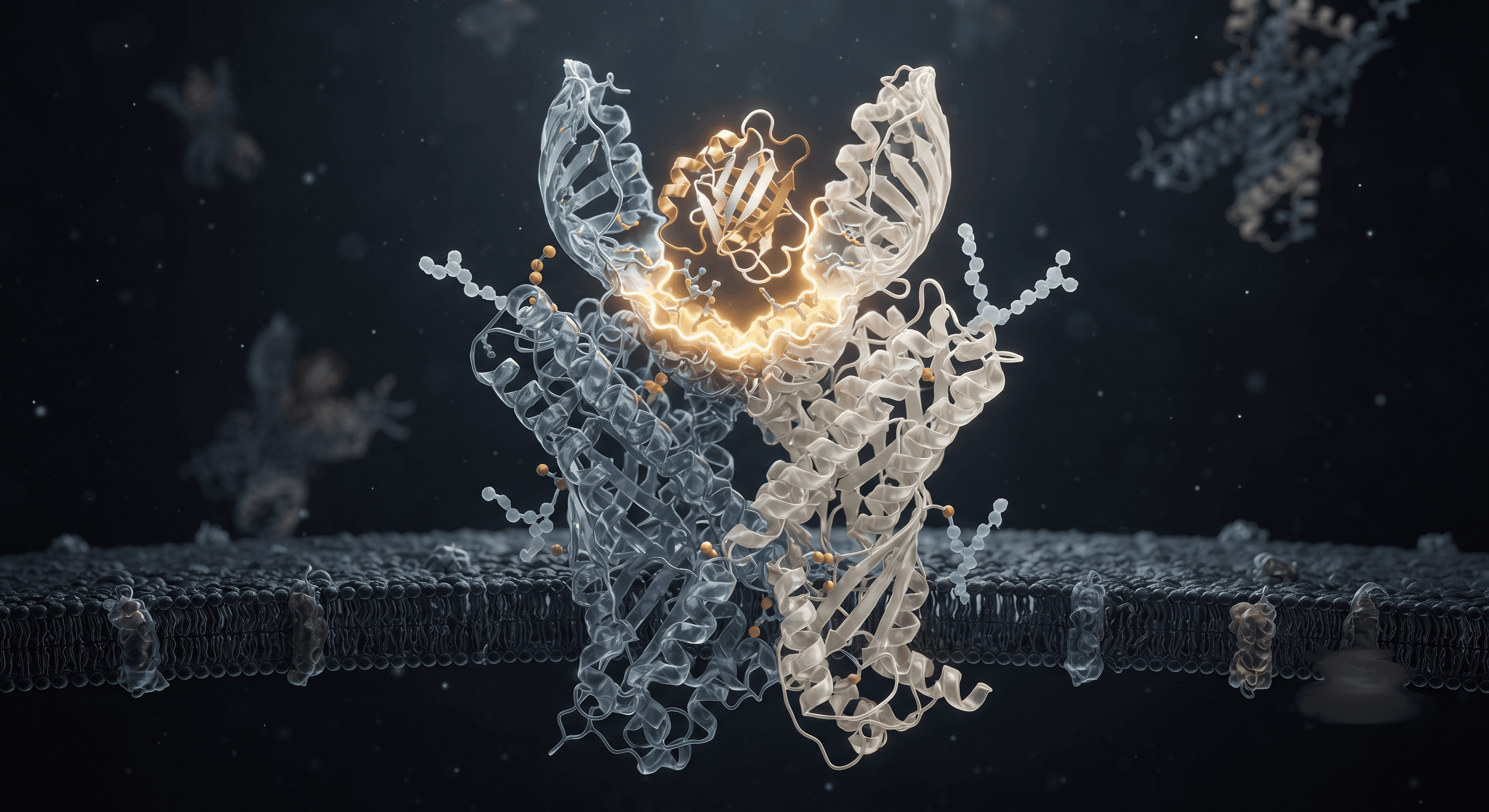
Illustrative only. Sweet proteins activate the same taste receptors as sugar.
They have existed for longer than the food industry. The reason they have not replaced sugar is not that they do not work — it is because extracting them from plant sources at the volumes commercial food manufacturing requires is not economically viable.
Precision fermentation changes that calculation.
What precision fermentation makes possible
Precision fermentation is the use of engineered microorganisms — typically yeasts or bacteria — to produce specific proteins by expressing the relevant genetic sequence in a controlled fermentation environment. The technology is not new. Insulin has been produced this way since the early 1980s. Animal-free rennet for cheese-making has been commercially available since the 1990s. Human serum albumin for pharmaceutical applications is routinely produced via microbial fermentation.
Applied to food proteins, precision fermentation allows production of compounds that evolution optimised over millions of years — at the purity, consistency, and industrial scale that commercial food manufacturing requires.
At Phyx44, we have taken this a step further. Our lead product, Swey, is not a direct replica of a naturally occurring sweet protein. It is a patented novel fusion protein — engineered from the structural and functional properties of whey and natural sweet proteins — designed to deliver multiple functions simultaneously: the sweetness intensity of a high-potency sweet protein, the protein content and functional properties of whey, and the processability that food manufacturers require.
Swey is currently at Technology Readiness Level 5/6. GLP safety and toxicology studies are currently under way. We are targeting commercial launch in the US and India by 2027.
The arithmetic of compounded savings
The economic and environmental case for Swey is not simply that it replaces sugar. It is that one kilogram of Swey potentially replaces one kilogram of whey protein and 50–100 kilograms of sugar — simultaneously, in the same product.
These are compounded savings. The land use, water intensity, and greenhouse gas emissions associated with producing conventional whey (from dairy) and cane or beet sugar (from irrigated monoculture agriculture) are both displaced by a single fermentation process. Formal lifecycle analysis of these figures is under way; we will publish the data when available.
The consolidation of the conventional sugar supply chain — as evidenced by recent strategic acquisitions in the ingredients sector — suggests that incumbent companies are beginning to price in exactly this kind of disruption. Consolidating before the technology matures is the industry response. We are building the technology.
Why we think the answer was always biology
We have been working on this problem for five years. We chose to publish now because the conditions that make a biology-first approach to food ingredients credible — and necessary — have aligned.
GLP-1 drugs are not a substitute for food reformulation. They are evidence of demand — evidence that metabolic disease is sufficiently prevalent and sufficiently consequential that a significant portion of the population will pursue pharmaceutical intervention rather than dietary change. The logical response to that dynamic is not more prescriptions. It is food that does not create the problem in the first place.
The world's sugar problem was never going to be solved by a better synthetic molecule. It needed biology to catch up with what nature had already designed.
We believe it just did.
Phyx44 Product
Swey™ — Sweet-dairy protein by precision fermentation
10× to 200× sweeter than sugar. Protein-rich. Designed for food manufacturing.